Yellow Books Cover Craft Back to School: A Practical Design Asset for Educators and Creators
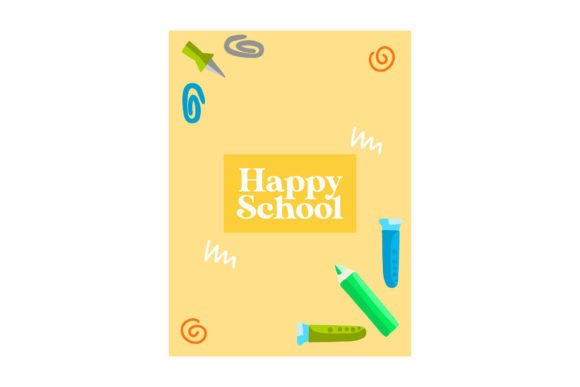
Yellow Books Cover Craft Back to School is a ready-to-use digital design resource tailored for professionals who need clean, school-themed book cover visuals—without starting from scratch. It’s not a template builder or subscription service; it’s a finite, high-resolution asset package designed for immediate integration into real projects. What sets it apart isn’t novelty or trend-chasing, but consistency of execution, format versatility, and thoughtful sizing—details that matter when you’re balancing tight deadlines with brand integrity.
What You Actually Receive—and Why Format Variety Matters
The package delivers six distinct file formats on a consistent 1920px × 1280px canvas: one AI (Adobe Illustrator), one EPS, one SVG, one DXF, one JPG, and one PNG. This isn’t just “more files for the sake of it.” Each serves a functional role in different workflows:
- AI and EPS files preserve vector scalability and layer integrity—ideal for designers adjusting typography, color, or layout in professional print or multi-platform publishing pipelines.
- SVG supports responsive web use, especially for educators embedding covers into learning management systems (LMS), blogs, or digital course portals where crisp rendering across devices is non-negotiable.
- DXF enables compatibility with laser cutters or CNC tools—useful for makers creating physical classroom displays, custom notebooks, or tactile learning aids.
- JPG and PNG provide quick-deploy options: JPG for email newsletters or social previews where file size matters; PNG for overlays, presentations, or sites requiring transparency (e.g., placing the cover over a photo background without white edges).
This breadth means you’re not locked into a single software ecosystem or output channel. A freelance curriculum designer can tweak colors in Illustrator, export a web-optimized SVG for a client’s WordPress site, and send a print-ready JPG to a local printer—all from the same source asset.
Design Integrity and Real-World Usability
The yellow-centric palette isn’t arbitrary. It aligns with widely recognized visual cues for academic energy, clarity, and approachability—think highlighter-yellow emphasis, not caution-tape intensity. The composition avoids clutter: balanced negative space, legible hierarchy, and subtle texture or line work that holds up at both thumbnail and full-page scale. It doesn’t rely on photorealistic imagery or trendy gradients that date quickly. Instead, it uses flat, intentional shapes and restrained contrast—making it adaptable across age groups (from elementary resource guides to professional development handbooks) and easily editable for localized messaging.
In practice, this translates to reliability. We tested the AI file in Illustrator 2023 and Affinity Designer: layers were logically named, text was converted to outlines (preventing font substitution issues), and grouping was intuitive—not overly nested, not unnervingly flat. The SVG rendered cleanly in Chrome, Safari, and Firefox without script dependencies. The PNG maintained alpha transparency without fringing. No hidden raster elements compromised scalability in the vector files. That level of technical diligence reduces troubleshooting time—especially important when supporting multiple stakeholders (e.g., a school district communications team coordinating with external printers and web developers).
Who Benefits Most—and Where It Fits Naturally
Yellow Books Cover Craft Back to School serves professionals whose work intersects education, content creation, and small-scale production. Consider these realistic use cases:
- Educators and instructional coaches building printable PDF workbooks, summer reading packets, or professional learning modules—where branded, cohesive covers reinforce credibility and reduce cognitive load for learners.
- Freelance editors and self-publishing consultants supporting authors of educational nonfiction or children’s activity books. Having a polished, school-aligned cover option speeds up mockup delivery and gives clients confidence in visual direction before commissioning custom art.
- Small publishers and edtech startups launching limited-run print resources or downloadable toolkits. Using this asset maintains visual continuity across product lines without diverting budget toward bespoke illustration for every title.
- Marketing coordinators at tutoring centers or after-school programs producing branded take-home materials—handouts, progress trackers, or parent guides—where a unified “back to school” aesthetic strengthens recognition across touchpoints.
It’s less suited for large commercial publishers needing fully original IP or highly specific grade-level iconography (e.g., kindergarten vs. AP Chemistry). Nor does it replace strategic cover design for narrative-driven children’s books where character expression and scene storytelling are central. Its strength lies in utility—not uniqueness.
Practical Considerations and Limitations
While the file variety is a clear advantage, keep in mind that this is a static design—not a customizable generator. You’ll edit colors, text, and minor elements manually in your preferred software. If your workflow relies heavily on Canva or Google Slides, you’ll need to import the PNG or JPG and work within those platform constraints (e.g., no vector resizing, limited layer control). Also, while the yellow base is versatile, users requiring strict adherence to institutional color palettes (e.g., exact Pantone matches for district branding) should verify color values in their editing environment before finalizing print jobs.
There’s no license documentation included in the description, so users should confirm permitted usage rights directly with the seller—particularly regarding resale of derivative works or inclusion in subscription-based design kits. For most individual or internal organizational use, it functions as expected; for redistribution scenarios, verification is prudent.
Making It Work in Your Workflow
To maximize value, start by auditing your current cover production bottlenecks. Are you spending 45 minutes sourcing royalty-free images, adjusting aspect ratios, and testing font pairings for each new PDF guide? Yellow Books Cover Craft Back to School eliminates those steps for standard academic formats. Import the AI file, swap out placeholder text with your title and author, adjust the yellow hue to match your existing brand swatch (if needed), and export for your intended medium.
For teams, treat it as a shared baseline—not a final deliverable. Use the SVG version as a reference in Figma or Adobe XD for UI consistency across digital learning assets. Save edited versions with clear naming conventions (e.g., “Cover_BackToSchool_MathGrade5_v2.svg”) to maintain version control. And if you regularly produce seasonal content, consider pairing it with complementary assets—like matching divider tabs or certificate borders—that follow the same design language.
Ultimately, Yellow Books Cover Craft Back to School earns its place not by being flashy, but by being dependable. It respects your time, accommodates varied technical environments, and delivers predictable results. When your goal is clarity, cohesion, and efficiency—not viral aesthetics—this kind of focused, well-executed asset quietly makes a difference.