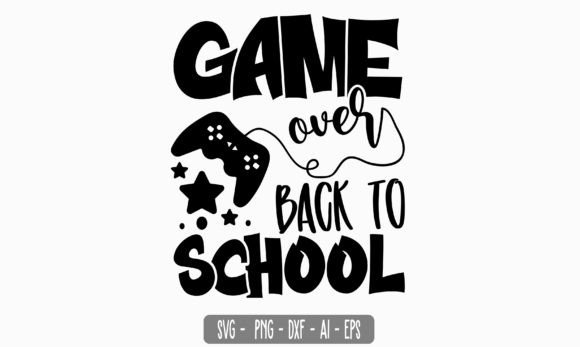
Game Over Back to School: A Digital Design Asset That Fits Real Creative Workflows
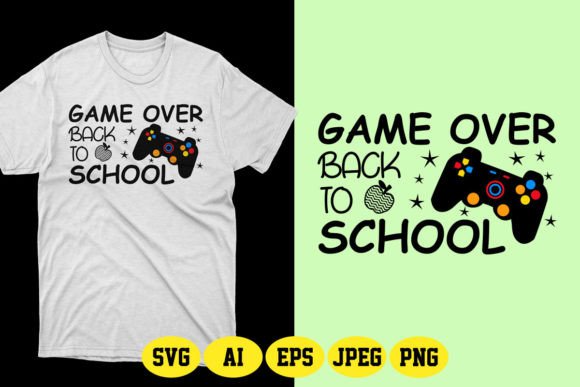
“Game over Back to school” isn’t just a nostalgic phrase—it’s a strategic design motif gaining traction among professionals who build, brand, and sell in today’s fast-moving education-adjacent markets. When paired with SVG, T-shirt-ready lettering, and delivered as a commercial-use digital file, it becomes more than decoration: it’s a production-ready asset engineered for speed, scalability, and cross-platform execution.
This isn’t novelty merchandise. It’s infrastructure—designed for creators, entrepreneurs, and small business owners who need to ship branded apparel, classroom resources, or promotional campaigns without reinventing the wheel. The listing delivers AI, SVG, PNG, DXF, and EPS files—formats that plug directly into industry-standard tools like Cricut Design Space, Silhouette Studio, Adobe Illustrator, and most print-on-demand (POD) platforms. And because the listing is a digital file, there’s no inventory risk, no shipping delay, and no physical fulfillment bottleneck.
Why “Game Over Back to School” Resonates Beyond the Classroom
The phrase taps into a cultural pivot point: the transition from summer autonomy back to structured learning. But its appeal extends well beyond students and teachers. Marketers use it in back-to-school email campaigns to signal fresh starts. Small-batch apparel brands lean into its playful irony to differentiate from generic “First Day of School” designs. Even corporate training teams adopt it internally—framing onboarding or upskilling programs as “leveling up” rather than compliance.
What makes Game over Back to School, SVG, T-shirt especially valuable is how precisely it balances tone and utility. It’s irreverent enough to stand out in a crowded visual landscape—but clean, legible, and scalable enough to work across applications: embroidered patches, heat-transfer vinyl on hoodies, screen-printed tote bags, or even vector-based signage for school supply pop-ups.
Digital Files Are No Longer Optional—They’re Operational Necessities
In 2024, creative professionals don’t just choose between analog and digital—they optimize for interchangeability. A single design must perform equally well on a 3-inch iron-on decal and a 48-inch vinyl banner. That demands format flexibility—not as a convenience, but as a baseline requirement.
This is where the inclusion of AI, SVG, PNG, DXF, and EPS files matters strategically:
- SVG ensures crisp rendering at any size—critical for responsive web assets or mobile-first marketing materials;
- DXF enables precise CNC or laser-cutting workflows, supporting makers building custom classroom displays or STEM kits;
- PNG with transparent backgrounds integrates seamlessly into social media graphics, email headers, or Canva-based templates;
- AI and EPS preserve vector integrity for professional print houses—no pixelation, no rework, no vendor back-and-forth.
For freelancers managing multiple clients—or solopreneurs launching seasonal collections—the ability to drop one design into five different production pipelines cuts hours off each project cycle. That’s not efficiency as a buzzword. It’s efficiency as margin protection.
Commercial Use Isn’t Just a Legal Clause—It’s a Business Enabler
The phrase THE LISTING IS A DIGITAL FILE THIS FILE IS FOR COMMERCIAL USE carries weight far beyond licensing fine print. It signals permission to monetize—not just once, but repeatedly, across channels and customer segments.
Consider these real-world uses:
- A freelance graphic designer licenses the Game over Back to School, SVG, T-shirt file to create a limited-run merch line for a charter school’s fundraising campaign—and retains full rights to reuse the same file for another client’s after-school program launch;
- An e-commerce entrepreneur uploads the PNG and SVG variants directly into Printful and Redbubble, generating passive income from teacher-targeted apparel—without negotiating usage rights or paying per-unit royalties;
- A curriculum developer embeds the vector lettering into editable Canva lesson slides, then sells the bundle on Teachers Pay Teachers—leveraging the commercial license to distribute derivative educational products.
This kind of reuse isn’t theoretical. It reflects how modern creative economies operate: modular, multi-output, and built on reusable digital foundations. The commercial-use designation removes friction—not just legal, but cognitive. Professionals can focus on strategy, positioning, and execution instead of parsing license tiers or seeking permissions.
Integration With Cutting Machines Is a Signal of Practical Maturity
Mentioning compatibility with Cricut and Silhouette Cameo cutting machines does more than list supported hardware—it communicates fluency with maker ecosystems. These platforms aren’t hobbyist afterthoughts; they’re professional-grade tools used by educators creating tactile learning aids, small manufacturers prototyping packaging, and retail brands producing localized in-store signage.
When a design ships with properly layered, contour-cut-ready DXF and SVG files, it tells users: We’ve tested this in the wild. No manual node cleanup. No scaling surprises. No missing registration marks. That level of polish reduces time-to-value from hours to minutes—especially important during seasonal peaks like July and August, when demand for back-to-school assets surges predictably.
Design as Infrastructure, Not Decoration
The rise of Game over Back to School, SVG, T-shirt reflects a broader shift: design assets are increasingly treated as infrastructure—reusable, interoperable, and embedded in operational workflows. This mirrors trends across adjacent domains: component-based UI libraries in web development, modular synth presets in music production, and standardized CAD parts in industrial design.
What used to be “just a logo” or “just a font” now needs to function as part of a system. It must scale, convert, embed, cut, print, animate, and adapt—often simultaneously. That’s why format diversity isn’t about checking boxes. It’s about ensuring the asset survives translation across contexts without degradation or dependency.
Looking Ahead: Scalability Without Sacrifice
As AI-assisted design tools mature—and as POD platforms expand into new categories like home décor, stationery, and wearable tech—the value of rigorously formatted, commercially licensed assets only increases. A design like Game over Back to School doesn’t need to evolve dramatically to stay relevant. Its strength lies in its precision, clarity, and readiness.
Professionals who prioritize such assets aren’t chasing trends. They’re building resilient creative practices—ones where seasonal demand doesn’t mean last-minute scrambling, where client revisions don’t require rebuilding from scratch, and where a single purchase supports dozens of downstream outputs.
That’s the quiet power of a well-structured digital file: it doesn’t shout. It enables. It fits. It scales. And in an economy where time is the scarcest resource, that’s not just practical—it’s essential.
If you’re sourcing assets for back-to-school campaigns, educator-facing products, or youth-oriented branding, treat Game over Back to School, SVG, T-shirt not as a decorative flourish—but as a functional component in your creative stack. Because when the season shifts, the work shouldn’t slow down. It should accelerate.